

It is one of the most common health conditions in America and a source of significant anxiety for millions of life insurance applicants: Can I secure an affordable policy if I have high blood pressure?
For Mike Miller, the family’s 40-year-old main breadwinner, this question was personal. He’d been managing his hypertension with medication for years. It was under control, but as he sat at his kitchen table waiting for the paramedic to arrive for his life insurance medical exam, the uncertainty was palpable.
“What if my reading is high today just because I’m nervous?” he confided in his wife, Sarah. “Will an underwriter see that one number and deny my application?”
It’s a universal fear—that a common diagnosis will automatically close the door to protecting your family. But the answer to the question is a resounding yes, you can absolutely get life insurance with high blood pressure. In many cases, if your condition is well-managed, you can still qualify for excellent rates.
The key lies in understanding that underwriters don’t look at a single snapshot in time; they review your entire health story. Today, we’ll follow Mike’s journey to approval and provide a clear roadmap to navigating the application process with confidence.
Your Guides for Today: The Miller Family
To make things simple, we’re using a fictional family to explore this topic.
- John & Mary (60s): The retired grandparents, focused on preserving their wealth and legacy.
- Mike & Sarah (40s): The parents, navigating their peak earning years, a mortgage, and saving for the future.
- Leo & Emily (Teens/Kids): The next generation, learning the basics of money.
The Principle of Control: What Underwriters Truly Evaluate

When the paramedic took Mike’s blood pressure, the reading came back 142/88—slightly elevated, just as he had feared. His heart sank.
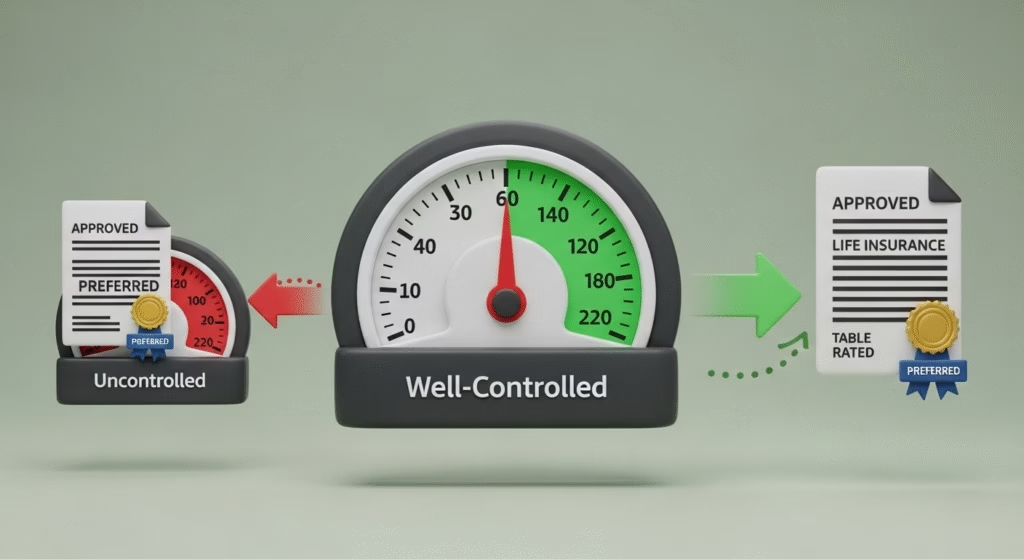
However, what Mike saw as a single “bad” number, a life insurance underwriter sees as just one piece of a much larger puzzle. The reading on the day of the exam is important, but underwriters are far more interested in one overarching principle: control over time.
A well-controlled condition demonstrates a responsible, health-conscious individual who is considered a good insurance risk. This “control” is the absolute key to securing favorable hypertension life insurance rates.
Alex’s Note: Underwriters are well aware of “White Coat Syndrome,” where a person’s anxiety in a medical setting can cause a temporarily high reading. A long history of stable numbers from your doctor’s office is far more powerful than a single reading taken on a stressful day.
Defining a “Well-Controlled” Condition
Here is what “well-controlled” means from an insurer’s perspective:
- Consistent Treatment: You are actively following your doctor’s advice and taking medication as prescribed. A consistent pharmacy refill history is strong evidence of this.
- Stable Readings: Your medical records show a history of stable, healthy blood pressure readings during regular check-ups.
- No Related Complications: Your high blood pressure has not led to other health issues such as kidney damage, heart disease, or stroke.
- Positive Lifestyle Factors: You do not smoke, and you maintain a healthy Body Mass Index (BMI).
Mike’s slightly elevated reading was effectively balanced by a long medical history showing responsible management—and that’s what secured his excellent rating.
The Life Insurance Blood Pressure Chart: How Insurers Classify Risk
While every company’s guidelines are proprietary, they generally use a framework to place applicants into a health class. For life insurance, high blood pressure is categorized based on your average readings and level of management.
| Health Class | Typical Reading Range (Age 40-50, With/Without Meds) | Key Underwriting Factors |
| Preferred Plus | Consistently below 135 / 85 (without medication) | Diagnosed in the past but no longer requires medication. Excellent health otherwise. |
| Preferred | Consistently below 140 / 90 (well-controlled with one medication) | Diagnosed over a year ago. Condition is stable with no other health issues. (Mike’s Category!) |
| Standard | Consistently below 150 / 95 (controlled with one or more medications) | Generally stable, though may have other minor concerns like slightly elevated cholesterol. |
| Substandard | Consistently above 150 / 95 | Readings may be less consistent, diagnosis is recent, or other complicating factors (e.g., obesity) are present. Coverage is still often available at a higher cost. |
While the AHA defines “Normal” as below 120/80, underwriters know that a perfectly healthy 45-year-old may consistently run around 130/80.
These are general estimates. For a detailed breakdown of blood pressure categories, authoritative medical sources like the American Heart Association provide the official clinical guidelines.
A Strategic Action Plan for Your Application
If you have high blood pressure, you have significant power to influence the outcome of your life insurance application.
1. Prepare Before You Apply:
- Consult Your Physician: Schedule a check-up to ensure your treatment plan is optimized and your readings are stable.
- Obtain Your Records: Ask your doctor for a copy of your recent medical records. This allows you to see exactly what the underwriter will see, eliminating surprises.
2. Be Transparent on Your Application:
- Disclose Everything: Provide the date of your diagnosis, all medications (name and dosage), and your doctor’s contact information. Hiding a diagnosed condition is considered insurance fraud and will result in an instant denial when your records are pulled during the underwriting process.
3. Demonstrate Consistent Management:
- Adhere to Your Treatment: A documented history of taking medication as prescribed is one of the strongest positive signals you can send an insurer.
What if You’ve Been Denied in the Past?
Being declined for life insurance for high blood pressure can be disheartening, but it is often not a permanent roadblock.
- Request the Reason: An insurer is required to tell you why you were denied. Often, it’s due to a specific high reading combined with another factor, which gives you a clear area to address.
- Improve and Reapply: If the denial was due to poor control, you can work with your doctor for 6-12 months to stabilize your condition and then reapply. Insurers are very receptive to a track record of improvement.
- Explore Other Options: In cases of severe, uncontrolled hypertension, you can explore no-medical-exam policies. While more expensive and with lower coverage amounts, “guaranteed issue” policies cannot deny you for health reasons and can provide a crucial safety net for final expenses.
Conclusion: It’s a Condition, Not a Disqualification
Two weeks later, the final verdict arrived. The underwriter had reviewed Mike’s full medical history, saw the long-term pattern of responsible management, and approved his policy at an excellent “Preferred” rate. His anxiety was replaced with profound relief.
Getting life insurance with high blood pressure is not about a single diagnosis or one reading on a stressful day. It’s about demonstrating a credible story of control. By partnering with your physician and showing a consistent history of proactive health management, you prove to an insurer that you are a responsible and insurable individual, fully capable of securing your family’s financial future.
Frequently Asked Questions (FAQ)
1. How much will hypertension affect my life insurance rates?
For well-controlled high blood pressure with no other health issues, the impact can be minimal; you may still qualify for “Preferred” rates. If your condition is less controlled or combined with other risks like smoking, you may be placed in a “Standard” or “Table Rated” class, which could be 25-100%+ more expensive.
2. What blood pressure is considered too high for life insurance?
There isn’t a single disqualifying number, but consistently untreated readings above 160/100 would make it very difficult to qualify for traditional coverage and would likely result in a decline or postponement. Treatment and control are the key factors.
3. Will my life insurance pay out for death from a stroke or heart attack?
Yes. As long as you were truthful about your high blood pressure on your application, your policy will pay out for any cause of death, including those related to cardiovascular disease. This is why full disclosure during the application is critically important.